




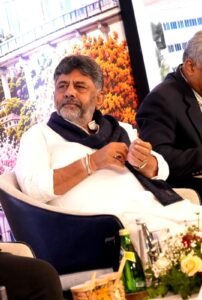

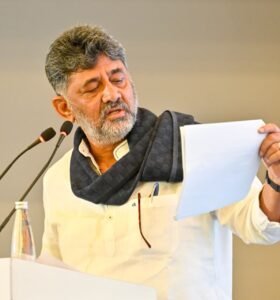
“It is essential for businesses to join hands through CSR funds to provide the best education and technological awareness to children in the rural areas of the state at the primary level,” Chief Minister DK Shivakumar called.
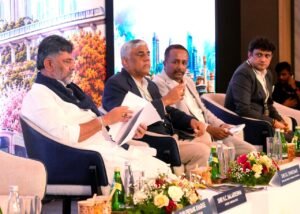
Shivakumar was speaking at the ‘Vision 2030 – CSR Conference-2026’ of the Greater Bangalore IT Companies and Industries Association (G BITCIA) held at a private hotel in Bengaluru recently.
“We should remember former President of India Pranab Mukherjee, who brought amendments to the CSR Act. Pranab Mukherjee gave a new direction to this country during the UPA government. The purpose of CSR is that we should all live not only for ourselves but also for others,” he said.
Commitment to develop 2,000 CSR schools
“Karnataka has a great heritage of charity. Thousands of years ago, great people here have done many social service works. People are migrating to cities for education and employment. To stop this, quality education should be provided in rural areas. Thousands of teacher posts are vacant in our government schools. We have announced a plan to develop 2,000 CSR schools in the budget,” he said.
CSR is an investment in society and the future of children.
“IT companies can develop government schools with their names. For example, there is an opportunity to brand the school with the company’s name. Assistance can be provided in any form, including computers, labs, vehicles, buildings. “There is no need to take money from the government and give money back to the government. You choose the contractor yourself and build the school. The government will provide the space and necessary cooperation,” he said.
“Some organizations are doing good work in CSR projects. The government has information on the performance of many organizations including Infosys and Wipro. Organizations that are doing good work will be encouraged. The three government schools built in the border area of Tamil Nadu are exemplary. Such projects will be expanded with the aim of ensuring that children in rural areas also get good quality education,” he said.
“Giving money through CSR is not just about helping the government. It is an investment in society and the future of children. Institutions should join hands in the development of rural schools according to their capabilities,” he called.
Bangalore is the global knowledge capital
“Bangalore is today a global knowledge capital and is home to top institutions like ISRO, HAL, National Law School, Indian Institute of Science,” he said.
New curriculum to understand the life of farmers and the hardships of agriculture
Children growing up in the city should directly understand rural life, agriculture and the hard work of farmers. For this purpose, I have requested the Bangalore Agricultural University to formulate a curriculum that makes a three-day village stay mandatory for students. City children should know how crops including millet and wheat grow, how milk is produced, and what difficulties farmers face. City life is not possible without knowledge of the hard work of farmers who produce food,” he opined.
“A litre of water is being paid in cities for ₹30 to ₹40. But the milk produced by farmers is getting around ₹40. This difference between the price of water and milk shows the condition of farmers. Children in the city do not know how milk, vegetables and grains reach our homes. There is a need to re-understand the importance of natural methods in agriculture,” he said.
Every private school should adopt a government school.
“The governing bodies of large private schools should adopt and develop at least one government school. Schools are a part of society’s responsibility and should contribute to the education sector. Private institutions should come forward to provide necessary facilities including infrastructure, quality of teachers, computers, laboratories, etc. in government schools,” he said.
25% seats arrangement-
“The system of providing 25% seats in private schools to economically backward children is costing the government thousands of crores of rupees every year. In the past, there were irregularities in this system. There were many problems including giving seats in exchange for money and interference of middlemen. There is a need to curb such irregularities,” he said.
Separate monitoring of CSR funds
“A separate IAS officer will be appointed to review how and where institutions are using CSR funds. The government will monitor the CSR activities of each institution. There is no need for a system of receiving money through the government and then transferring it to other institutions. The institutions themselves should directly undertake the development work of schools,” he said.
“The state has the potential to invest around ₹10,000 crore through CSR every year in various sectors. But the CSR expenditure in 2024-25 is only around ₹3,394 crore. The full potential of the CSR fund should be utilized for priority sectors like education and health,” he said.