
Bengaluru Jatre invites citizens to design the city’s everyday spaces, with ideas that could move from the drawing board to the streets
*Bengaluru Jatre invites designers, architects, artists, students and other creative thinkers to submit practical ideas for everything from streetlights, bus stops and public benches to road medians, waste bins, shopfronts and neighbourhood identities*
“Bengaluru’s everyday spaces must work better for every citizen”: Bengaluru Development Minister Krishna Byre Gowda invites people to participate and help redesign the city
*Shortlisted designs to be displayed during Bengaluru Jatre, December 4–13; best designs to be selected by a GBA jury*
Selected designers to meet the Minister for Bengaluru Development to discuss their ideas and how they can be taken forward
Bengaluru, October 25: What makes a city a pleasure to live in? Is it the grand infrastructure that transforms its skyline, or the small, everyday details that determine how people experience it – a bus stop that offers shelter from the rain, a well-lit street that feels safer after dark, a bench where an elderly person can rest, or a signboard that helps someone find their way through an unfamiliar neighbourhood?
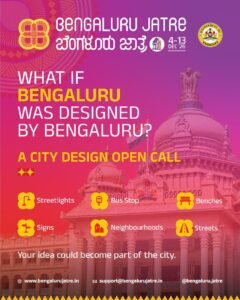
Bengaluru is inviting its citizens to help redesign these everyday elements of urban life. Bengaluru Design: Open Call, an initiative under Bengaluru Jatre, invites designers, architects, artists, students and other creative thinkers to submit practical ideas for everything from streetlights, bus stops and public benches to road medians, waste bins, shopfronts and neighbourhood identities. Participants can also propose improvements for an entire 500-metre stretch of the city.
Selected proposals will be showcased during Bengaluru Jatre, scheduled from December 4 to 13, 2026. Promising ideas will be shared with the relevant city corporations for consideration and possible implementation, subject to feasibility.
Bengaluru Development Minister Krishna Byre Gowda said, “A city is experienced not just through its major infrastructure, but through the everyday spaces people use. We want citizens to bring forward ideas that make Bengaluru more accessible, welcoming and liveable. This initiative is an opportunity to connect people’s creativity with the city’s needs.”
For Bengalureans, these are not abstract design questions. They are part of everyday life in a city where millions navigate busy roads, wait for public transport, walk through neighbourhoods and negotiate public spaces. Yet these ordinary surroundings often receive far less attention than big-ticket infrastructure projects. A thoughtfully designed bus stop, a safer-feeling street or a more welcoming public space can make a tangible difference to how people experience Bengaluru.
Idea behind the initiative
At its heart, the initiative poses a larger question: who gets to shape a city? Bengaluru Design: Open Call invites people who live in, work in and understand the city to look at familiar surroundings with fresh eyes and propose solutions that are practical, affordable, inclusive and distinctly Bengaluru. It is an opportunity to move beyond identifying what is wrong with the city and start imagining what could work better-one street, one public space and one everyday object at a time.
Imagine a student coming up with a better bus stop, an architect reimagining a pedestrian-friendly street, an artist giving a neighbourhood a distinctive visual identity, or a young designer finding a smarter way to make public spaces more accessible. The open call seeks to create a connection between creative thinking and the everyday realities of urban life, giving such ideas an opportunity to be seen, discussed publicly and considered for the city.
From streetlights to neighbourhood identities: Rethinking the everyday
The design challenges cover a range of objects, spaces and systems that influence how people experience Bengaluru. Each offers an opportunity to turn an everyday urban problem into a practical design solution.
1.Streetlights: Can lighting improve visibility and make streets feel safer for pedestrians while contributing to the character of a neighbourhood? Participants can rethink their form, placement and functionality.
2.Bus stops: How can they offer better shelter from rain and sun, comfortable waiting space, accessibility for people with disabilities and a more convenient experience for commuters?
3.Benches: Public seating can make streets and open spaces more welcoming, particularly for older people, children and those who need a place to pause. Ideas could explore comfort, accessibility, durability and placement.
4.Road medians: Often treated as merely functional dividers, road medians can enhance a street’s visual appeal through thoughtful greenery and attractive designs that account for road safety, maintenance and local conditions.
5.Waste bins: Could bins be designed and positioned to be easier to use, more visible, durable and simpler to maintain, while fitting naturally into the streetscape?
6.Signboards and civic signage: Participants can rethink signage through clearer lettering, intuitive navigation, consistent visual design and accessible information that helps residents and visitors find their way.
7.Shopfronts: Ideas could explore how shopfronts can become more attractive, coherent and inviting while preserving the individuality of businesses and the character of local markets.
8.Neighbourhood identities Participants can draw on the stories, history and culture of Bengaluru’s neighbourhoods to develop visual identities that celebrate local character while contributing to a recognisable citywide identity.
One of the more ambitious challenges goes beyond individual objects to ask participants to redesign an entire 500-metre stretch of the city. This calls for an integrated approach, bringing together pedestrian movement, road crossings, greenery, lighting, public transport, accessibility, safety and the character of the surrounding neighbourhood.
Can 5 Corporations have their own identity?
Another challenge explores the identity of Bengaluru’s five city corporations under the Greater Bengaluru Authority. How can each corporation reflect the character of its neighbourhoods while retaining a distinct yet connected visual identity that belongs to Bengaluru as a whole? The question brings together design, civic identity and the relationship between local communities and the larger city.
Good ideas must work on the ground
The open call is not simply an invitation to produce striking illustrations or ambitious concepts. Its emphasis is on designs that respond to the realities of the city. Proposals are expected to be practical, affordable, high-impact and scalable, taking into account existing infrastructure, available materials, maintenance requirements, accessibility and the processes involved in civic administration. The challenge is to imagine improvements that are not only attractive on paper but could also work in everyday conditions.
Krishna Byre Gowda said, “Good design must go beyond how something looks. It must work on the ground, be affordable to maintain, improve people’s everyday experience and be practical for our civic agencies to take forward.”
For Bengaluru’s young people, in particular, the open call offers a way to apply their ideas to the city they inhabit. Students and emerging designers need not wait until they are established professionals to think about better public spaces, more intuitive signage or more inclusive streets. The starting point could be something as simple as observing what does not work on the route they take to college, the bus stop they use every morning or the street where they live.
Shortlisted designs to be showcased at Bengaluru Jatre; winners chosen by a GBA jury
The connection with Bengaluru Jatre gives the open call a public platform. Selected submissions will be showcased in an exhibition during the festival, allowing citizens to encounter the proposals and offer feedback.
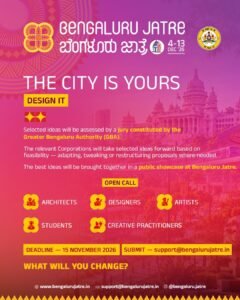
The strongest ideas will be assessed by a jury constituted by the Greater Bengaluru Authority. Selected proposals will be shared with the relevant city corporations for consideration and possible implementation, subject to technical, financial, operational and site-specific feasibility. The initiative thus creates a pathway for ideas to move from individual submissions into public discussion and, where feasible, further consideration by civic authorities.
The best designers will also be invited to meet the Minister for Bengaluru Development to discuss their ideas and how they might be taken forward. For a city known for its technology, creative talent and entrepreneurial energy, the opportunity is to channel that ingenuity into the everyday spaces millions share.
Krishna Byre Gowda said, “We want good ideas to come from everywhere -from students, designers and residents who understand their neighbourhoods. The best proposals deserve to be seen, discussed and considered for implementation wherever feasible.”
Design submission details
Submissions for Bengaluru Design: Open Call close on November 15, 2026. Entries can be sent to support@bengalurujatre.in.
Selected submissions will be showcased during Bengaluru Jatre, from December 4 to 13, 2026. The best designers will be invited to meet the Minister for Bengaluru Development to discuss their ideas and how they might be taken forward.