
India’s renewable energy capacity has increased 5X to 237 GWs since 2016
- InvITs emerge as a key financing solution for renewable energy
- Less than 2% of operational renewable capacity has been monetised through InvITs
Mumbai, August 11, 2026: Knight Frank India, in its latest research study, Deepening InvITs for Capital Recycling in Renewable Energy, cited that India faces an annual renewable energy financing gap of nearly USD 35-bn[2]as the country progresses towards its 500 GW non-fossil fuel energy capacity target by 2030. India’s non-fossil fuel capacity, led by renewables, has increased fivefold over the past decade, from 59 GW in 2016 to 300 GW as of July 2026. The country needs to add nearly 200 GW over the next four years, requiring annual capacity additions of around 50 GW. This will require annual investments of USD 48-54 bn, significantly above the current annual investment of USD 13-18 bn.
Annual Fossil Fuel Capacity Additions Needs More than Doubled to 50 GW by 2030
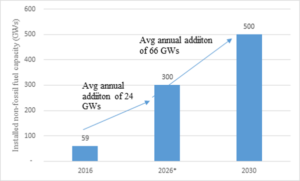
Source: Ministry of New and Renewable Energy
| Financing opportunity through InvITs |
With private developers accounting for over 90% of the country’s renewable energy capacity, the need for efficient capital recycling has become increasingly critical. Further, the report states financing renewable energy projects in India remains almost 80% more expensive than in mature international markets. In this backdrop, Infrastructure Investment Trusts (InvITs) can emerge as a critical financing solution. As per the report, less than 2% of India’s operational renewable capacity has been monetised through InvITs, underscoring the untapped opportunity.
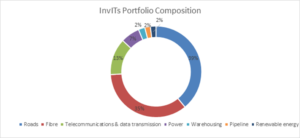
Source: Company reports, Knight Frank Research, Note: As of FY 2026
Shishir Baijal, International Partner, Chairman and Managing Director, Knight Frank India said, “India’s renewable energy journey has now reached an inflection point where financing innovation will be as important as capacity addition. While the country has made remarkable progress in expanding renewable energy capacity, achieving the 500 GW target by 2030 will require significantly higher and more efficient capital deployment. InvITs can play a transformative role by unlocking capital embedded in operational renewable assets, reducing the cost of capital over time, and accelerating investments into the next generation of renewable energy, storage and transmission infrastructure. As operational renewable portfolios continue to mature, we expect InvITs to emerge as a mainstream financing avenue supporting India’s long-term energy transition.”
Existing Renewable InvITs Offer a Compelling Yield Opportunity
Operational renewable energy assets have demonstrated strong potential as income-generating infrastructure investments. Backed by long-term power purchase agreements and predictable cash flows, renewable InvITs can offer stable distributions to investors while providing developers with an efficient capital recycling mechanism. The report highlights that successful renewable InvIT platforms have consistently delivered cash distribution yields of around 10-10.5%, demonstrating that utility-scale renewable assets can combine long-term income visibility with growth, making them increasingly attractive to domestic and global institutional investors.
Renewable Energy Transition – INR 3.2 trn Worth Solar Assets Identified as InvITs -Eligible
India’s renewable energy sector has witnessed significant capacity expansion over the past decade, with solar power emerging as the primary growth driver. Supported by declining technology costs, competitive tariff discovery, improved project execution and favourable policy measures, installed solar capacity has grown nearly thirteen-fold since 2016 and now accounts for more than half of the country’s renewable energy capacity.
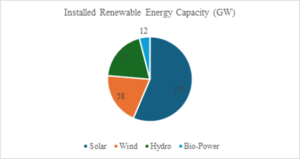
Source: Ministry of New and Renewable Energy
The current renewable energy mix comprises 165 GW of solar, 58 GW of wind, 57 GW of hydro and 12 GW of bio-power capacity. Also, as per the report, only a 3 GW of solar assets, equivalent to 2.3% of the operational utility scale solar assets has been monetised through InvIT structures, indicating considerable untapped potential. Given the maturity, scale and long-term contracted cash flows of utility-scale solar assets, Knight Frank India has identified an estimated that operational utility scale solar assets with a value of INR 3.1 trn eligible for InvITs.
Outlook for Renewable InvITs
Knight Frank India’s research highlights that providing developers with an avenue to monetise operational assets and reinvest capital into new generation capacity, storage and hybrid projects, InvITs can improve capital efficiency across the renewable ecosystem. The report further noted, as the renewable asset base matures, the availability of operational assets with long-term contracted cash flows will create a stronger pipeline of InvIT-ready opportunities.
A well-developed renewable InvIT market can also diversify the sources of infrastructure financing beyond traditional bank lending, enabling greater participation from pension funds, insurance companies and global infrastructure investors. Over time, this can contribute to reducing financing constraints, improving asset valuations and strengthening investor confidence in India’s renewable energy sector.